“Korea will have no problem leading G20 discussions at the Seoul summit and we have been organizing everything appropriately,” Vice Finance Minister Lim Jong-ryong told The Korea Herald on Wednesday.
2010년 10월 13일 수요일
Seoul refutes Japan’s doubt on its G20 role
The Korean Finance Ministry rejected Japan’s questioning of Seoul’s leadership as the chair of G20 and said Korea has the ability to successfully mediate all agendas on the table for the G20 Seoul Summit slated for Nov. 11-12.
“Korea will have no problem leading G20 discussions at the Seoul summit and we have been organizing everything appropriately,” Vice Finance Minister Lim Jong-ryong told The Korea Herald on Wednesday.
Hwang’s death puts leftists in dilemma
As South Korea mourns the death of Hwang Jang-yop, a top North Korean defector, its left-leaning politicians are finding themselves in an awkward position, given their strained relationship with the deceased.
While politicians from the right-wing Grand National Party showed up in sequence at the mortuary where Hwang’s body is kept soon after his death Sunday, the liberal opposition Democratic Party hesitated for days, agonizing over whether or not to pay tributes to him.
On Tuesday afternoon, the DP sent a delegation headed by floor leader Rep. Park Jie-won. Its chairman Sohn Hak-kyu, however, will not visit his altar in person, party officials said.
“There were pros and cons,” a party insider was quoted by the Yonhap news agency as saying.
“While some said we should pay respects to Hwang as he lived such a tragic life as a victim of the division of the two Koreas, others urged caution, insisting that such an act could have an impact on relations with North Korea in the future,” the official said.
Rep. Chung Jung-bae, a member of the DP’s top decision-making Supreme Council, said, “Hwang can be seen as a victim of the division of the Korean Peninsula, but I don’t think (he was someone who) the party should consider paying its formal tribute to.”
| Former President Kim Young-sam pays tribute to the late North Korean defector Hwang Jang-yop at a Seoul hospital Tuesday. (Joint Press Corps) |
Samsung’s heir apparent may take bigger role soon
Speculation is rising that Samsung’s heir apparent Lee Jae-yong may take on greater responsibility in business operation next year after Samsung Electronics chairman Lee Kun-hee said the organization needs to get younger on Tuesday.
“An organization must be young in any era,” Lee said in response to reporters’ questions at Gimpo Airport while on his way to attend the general meeting of the Association of National Olympic Committees in Mexico.
His statement was issued at a sensitive time for the group, only a few months ahead of its yearend reshuffle scheduled in December.
Some assumed that the time may have come for the business tycoon’s only son Lee Jae-yong to take a bigger voice in running and managing the country’s top business conglomerate, while others believed this may be pointing to a drastic reshuffle.
| Lee Jae-yong |
Assistance to poor near top of summit agenda
Tackling the nagging challenge of narrowing the gap between the advanced and underdeveloped nations is to be one of the main priorities of the G20 summit Seoulis to host Nov. 11-12.
The November meeting will be the first in which development issues are placed at the forefront since the heads of state of the 20 members began convening in 2008.
Experts said the emphasis on development issues was a reflection of critical evolution of the G20 as they expand on the type of global crises or challenges they try to meet.
SaKong Il, chief of the Presidential Committee for the G20 Summit, emphasized that helping less-developed nations help themselves will be one of the key initiatives the summit will be pursuing.
“We are looking for ways to help developing economies become independently competent without relying on external aid so they may achieve sustainable growth,” he said.
As agreed in previous G20 meetings, November’s summit is to be focused mainly on two pillars; discussion on building a counter-crisis global financial system and creating a sustainable growth base for underdeveloped countries.
Initially, the summit attended mostly to policies and related technicalities for coping with financial crises since the group was born amid the 2008 global financial meltdown policy issues and the global financial organizations.
South Korea was seen as the most appropriate candidate to handle the new agenda, due to its status as an emerging market.
It also boasts a surprisingly rapid rise to industrial development, despite that it suffered from colonial rule in the early 1900s, followed by a civil war that has left the Korean Peninsula divided.
| Lim Won-hyuk, a director at the Korea Development Institute, speaks at the G20 High-Level Development Conference organized by the Presidential Committee for the G20 Summit in Seoul on Wednesday. (Yonhap News) |
Debate heats up on economic outlook
Paul Krugman and Niall Ferguson, two towering figures in contemporary economics, sparred again over global economic outlook and exit strategies from stimulus measures
The two scholars participated in the World Knowledge Forum organized by a Korean media firm Wednesday, offering contrasting views on major economic issues as they did last year.
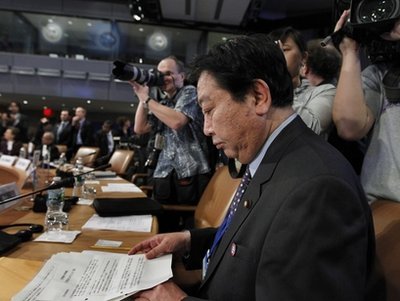
Seoul refutes Japan’s doubt on its G20 role
The Korean Finance Ministry rejected Japan’s questioning of Seoul’s leadership as the chair of G20 and said Korea has the ability to successfully mediate all agendas on the table for the G20 Seoul Summit slated for Nov. 11-12.
“Korea will have no problem leading G20 discussions at the Seoul summit and we have been organizing everything appropriately,” Vice Finance Minister Lim Jong-ryong told The Korea Herald on Wednesday.
| Japanese Finance Minister Yoshihiko Noda (AP-Yonhap News) |
Path of Kim Jong-il’s other sons
It is like the story of a one-time crown prince called Yangnyeong at the beginning of the Joseon Dynasty. The eldest son who was initially deemed the next in throne loses his status to his younger brother after falling out of his father’s favor for misbehavior. The defamed, womanizing son goes into exile.
Only this time, in North Korea, the brothers’ country faces an opaque future.
Because he is the eldest, Jong-nam, born in 1971, was often considered the most likely son to succeed North Korean leader Kim Jong-il. That was until 2001 when he got caught trying to enter Japan on a fake Dominican passport bearing the name Pang Xiong which means “Fat Bear” in Chinese. He told the police that he wanted to go to Tokyo Disneyland, which greatly enraged his father. After several days of detention, Jong-nam was deported to China, making Kim Jong-il cancel a scheduled trip to China out of embarrassment to both countries.
Prior to the globally publicized 2001 incident, Jong-nam had reportedly made several secret visits to Japan, starting as early as 1995.
Several years after the eldest son’s fallout, speculation rose over whether the throne would go to second son Jong-chol, as it usually did during the Joseon Dynasty.
Unlike his elder brother who was tutored and educated in North Korea’s elite school, Jong-chol, born in 1981 to a different mother, was educated in Switzerland for five years until 1998.
It was only early last year that the outside world learned that the “Dear Leader” finally decided to pass on his legacy to the third and youngest son Jong-un, born in 1984.
피드 구독하기:
글 (Atom)