2010년 10월 24일 일요일

G20 puts currency disputes to rest in Seoul


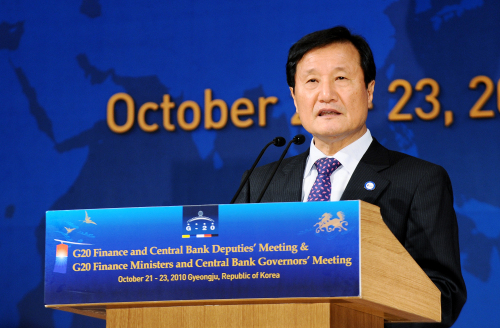
GYEONGJU The U.S., Europe and leading emerging countries struck a compromise to fend off a currency dispute on Saturday by agreeing to refrain from competitive devaluations and to give newly rising powers a greater say in the International Monetary Fund.

The finance ministers and central bank chiefs from the Group of 20 avoided explicitly backing a U.S.-led proposal to set caps on national current account balances, but called on its members to keep imbalances at sustainable levels.

They adopted a joint communiqu wrapping up their two-day talks in Gyeongju, North Gyeongsang Province. The meeting was designed to set the agenda for their leaders’ summit scheduled for Nov. 11-12 and find common ground to prevent the ongoing currency battle from derailing the global recovery.

The G20 members “will move towards more market determined exchange rate systems that reflect underlying economic fundamentals and refrain from competitive devaluation of currencies,” the statement said.

It also called for advanced economies to take measures to help mitigate the risk of excessive volatility in capital flows facing some emerging countries.

“Advanced economies, including those with reserve currencies, will be vigilant against excess volatility and disorderly movements in exchange rates.”

It was the first time for the finance chiefs to deliver a common stance on currency policy.

China and other emerging economies, believed to weaken their currencies to boost exports, accepted the language as the G20 agreed to a landmark overhaul of the IMF, designed to better reflect the growing importance of the emerging economies,

The G20 agreed to transfer more than six percent of the voting rights in the IMF to rising powers including China. Europe will relinquish two of its nine seats at the 24-member Executive Board.

IMF Managing-Director Dominique Strauss-Kahn hailed it as the “biggest” reform in the fund’s history.

The G20 said the agreement will help deliver a more effective, credible and legitimate IMF and enable it to play its role in supporting the operation of the international monetary and financial system.

KEPCO wins power plant deal from UAE

The state-run Korea Electric Power Corp. said Monday that along with Sumitomo Corp. of Japan, it has won a $1.5 billion deal to build and operate a power plant in the United Arab Emirates.

The gas-fired power plant, with a capacity of about 1,600 megawatts, will be built in Shuweihat, 260 kilometers west of Abu Dhabi, and is scheduled to begin operations in March 2014, KEPCO said.

The contract was awarded by the Abu Dhabi Water and Electricity Authority.

Last year, the KEPCO-led consortium won a $20 billion project from the UAE to build four nuclear reactors in the Middle Eastern country.

Since a consortium led by KEPCO won a $20 billion deal to build four nuclear power plans in the UAE by 2020, the state-run energy firm has been showing more agressive moves to expand its overseas markets.

While concretizing similar projects to build nuclear reactors in Turkey, KEPCO has been invoved in dialogues with countries including Argentina, Malaysia and South Africa to enhance their cooperation regarding energy, as well as for possible prospective nuclear plant constructions.

UFO alert over Manhattan

White spots that looked like UFOs appeared in the sky over New York City, prompting thousands of people to look into the sky Wednesday morning, the Daily Mail reported Thursday. 

Those white spots floated 1.5 km above 23rd Street and Eighth Avenue and slowly disappeared as the day progressed. “There were none left at about 4:30 p.m.,” said a Fox News reporter

Korean classic goes on sale

A Hyundai Pony, which was the country’s first locally developed passenger car, is on sale at the online used car site Bobaedream.

The three-door hatchback is equipped with a 1.4-liter, four-cylinder engine that puts out 92 brake horsepower, and manages 15 kilometers per liter of fuel. 
 

POSCO seeks expansion in Ukraine

POSCO, the world’s fourth largest steelmaker, is seeking an additional boost for its projects in Ukraine in the form of government backing.

POSCO chief executive Chung Joon-yang met with Ukrainian President Vickor Yanukovytch and Prime Minister Mykola Aza rov in Kiev on Wednesday and Thursday, respectively, to discuss its ongoing projects in the country. Chung discussed issues concerning the collaborative projects with Ukrainian steel company Metinvest Holding and Smart Holding at the meetings, the company said.

He also requested the Ukrainian government’s support for POSCO subsidiaries to take part in infrastructure projects including port and road construction in the future.

In response, the Ukrainian leaders promised full support if the steelmaker proposed detailed plans for such projects, the company said. 

According to the company, Chung also said that POSCO can help Ukraine in updating technologies and equipment related to steelmaking, and expressed the interests of POSCO and its subsidiaries in participating in a wide range of projects including alternative energy and smart grid programs.

Hyundai Motor seeks new vehicle venture in China

Hyundai Motor Co., Korea’s largest automaker, plans to form a 500 billion won ($443 million) venture with Ziyang Nanjun Automobile Co. in China next year to expand its market share in the world’s biggest auto market. 

The companies signed an agreement Thursday to form the partnership to build commercial vehicles, in which each will have a 50 percent share, Hyundai said in an e-mailed statement. The venture will take over Ziyang’s commercial-vehicle operation, which has annual output capacity of 120,000 vehicles. It will target 90,000 heavy truck and bus sales in China next year, rising to 300,000 in 2015, the statement said. 

G20 makes headway in tackling imbalances

GYEONGJU Group of 20 financial officials on Saturday made headway in their efforts to calm currency strains and tackle trade imbalances that threaten to destabilize the global economy.

Before the two-day meeting in Gyeongju, the U.S. had proposed capping national current account surpluses and deficits as a way of reducing trade gaps while circumventing currency disputes. 

The G20 stopped short of setting specific targets in the face of resistance fromJapanGermany and other key exporting countries.

But the issue made it into the joint statement as a crucial agenda item for further discussion in the lead up to the G20 leaders’ summit in November.

“We will strengthen multilateral cooperation to promote external sustainability and pursue the full range of policies conducive to reducing excessive imbalances and maintaining current account imbalances at sustainable levels,” the statement said.

The International Monetary Fund will devise “indicative guidelines” to assess the degree of imbalances in cases of prolonged trade surpluses or deficits.

“Persistently large imbalances, assessed against indicative guidelines to be agreed, would warrant an assessment if their nature and the root causes of impediments to adjustment as part of the Mutual Assessment Process, recognizing the need to take into account national or regional circumstances, including large commodity producers,” the Gyeongju communiqu stated.

Banknotes from different countries at the main office of the Korea Exchange Bank. (Reuters-Yonhap News)