2010년 5월 16일 일요일

[KOSDAQ report (51)] POSCO Chemtech eyes lithium ion battery market

This is the 51st in a series of articles analyzing companies listed on the KOSDAQ, Korea’s secondary stock market loaded with tech firms. - Ed.

POSCO Chemtech, the POSCO subsidiary that specializes in refractory and lime production, will produce materials for lithium ion battery cathodes in 2013.

“We will begin producing materials for lithium ion battery cathodes in 2013, and raise the company’s annual revenues to 3 trillion won ($2.6 billion) by 2015,” POSCO Chemtech president Lee Sang-young said. 

“The tar produced by POSCO each year will provide the raw materials. It will mean the localization of materials used in lithium ion batteries, which are currently mostly imported.” 

POSCO Chemtech chief executive Lee Sang-young (POSCO Chemtech)
Tar, which is generated as a byproduct in the process of making coke from coal, needs to undergo three-step processing to make materials for lithium ion battery cathodes. According to POSCO Chemtech, each stage results in marketable products and the company plans to manufacture all three products.

For the new business, the company is looking to collaborate with a Japanese company producing lithium ion battery materials. The company is also considering plans to take over a local firm that has related technologies.

According to company officials, it has secured 300,000 square meters of land to build production facilities, and is reviewing ways to secure 200 billion won funds required for the project.

Although the project is still in the early stages, and it will be some time until POSCO Chemtech will see any return from the investment, the company has seen significant growth from its existing businesses. 

The company’s revenues rose by 28.5 percent from 2008 to come in at 574.4 billion won last year, while operating profits increased by 29.3 percent over the same period to 41.5 billion won.

The company has continued on an upward slope so far this year, with first quarter figures rising to record levels.

The company’s first quarter sales increased by 22.9 percent from the previous quarter to 160.8 billion won and operating profits jumped by 114.8 percent to 14.2 billion won.

Over the same period, POSCO Chemtech’s net profits increased by 153.9 percent to come in at 12 billion won. Lee attributed the rise to the company’s lime business, which accounted for 42.5 percent of the company’s 2009 sales. 

For this year, Lee said that the company is targeting 700 billion won sales and 60 billion won operating profits.

Concerning share prices, Lee said that POSCO Chemtech shares are still undervalued, and that as the average price earning ratio for 2008 and 2009 is 8.7, the company’s shares should be at least 70,000 won.

No need to fret over Europe crisis, experts say

No need to fret over Europe crisis, experts say 

Watching the Greek debt crisis, many Koreans fear that the country’s robustly-recovering economy may get bogged down again by a problem from outside the country, and thus one they have no control over. 
However, foreign experts participating in a forum in Seoul yesterday, saw the likelihood of that happening being very low. 
“(The European debt crisis) is not going to have the same impact (on Korea) as the U.S. subprime debt crisis had in 2008,” said Jeffrey Shafer, vice chairman of Citi’s Global Banking. 
What’s going to happen is that global investors will look for safer places to park their money instead of trouble-ridden European countries, which will benefit Korea and emerging economies in Asia, he said. 
The challenge for Korea will be how to keep that money coming in and not lose control, he added. 
Some Southern European countries are struggling with huge government debt, after spending aggressively to fight a global economic recession. The European Union and the International Monetary Fund are planning a rescue package for Greece and other crisis-hit countries. 
Michael Pomerleano, an advisor at the World Bank in Washington, was upbeat that Korea would continue economic growth, avoiding the fallout of the European troubles, although he offered a very grim outlook for Greece. 
“Greece will default. The only debatable issue is when,” he said. “Asia, however, is far more robust than the rest of the world and is increasing trade with other vibrant emerging economies,” he added. “It is time that Korea thought strategically about repositioning its (trade) focus.”
China, for example, has become a bigger trade partner for Brazil than the United States is, he said. 
Choi Do-soung, a member of the Bank of Korea’s Monetary Policy Committee, said the European problem was unlikely to spark another global crisis financial crisis. 
“Even if the worst-case scenario becomes reality, I think Korea still has measures available to respond to the crisis,” he said. 
Authorities here have repeatedly said that the eurozone woes will not have a major impact on Korea, citing the nation’s low level of exposure to the troubled European countries. 

Potholes line road to electric car era

uch-hyped neighborhood electric vehicles are struggling to catch the attention of drivers more than a month after they were approved to run on roads.

A revised law on automobile safety and management took effect March 30 allowing local governments to designate roads on which the low-performance electric cars -- which run at less than 60 kilometers per hour and weigh less than 1,361 kilograms -- are available.

“By percentage, about 30 percent of local governments have designated roads for electric cars and have reported the designations to the ministry,” an official at the Ministry of Land, Transport and Maritime Affairs’ Motor Vehicles Policy Division said.

“But, because they are only required to tell us within 20 days of roads being designated for electric cars and an increasing number of local governments are doing so, the number we have now is inexact and growing fast.”

Neighborhood electric vehicles manufactured by local firms use a recharging station installed at a Homeplus store in Seoul. Yonhap News
However, even with regulatory barriers removed, NEVs have yet to take off in Korea.

While CT&T, the country’s leading NEV maker, has exported its e-Zone electric car and signed on with Korean government agencies to supply the vehicle, e-Zone cars have yet to catch on with private motorists.

According to the company, only three or four have been sold to private consumers.

“The main cause is the lack of subsidies. The Japanese government provides different subsidies depending on the vehicle. For e-Zone the amount is about 700,000 yen, which is about 9 million won ($8,000),” a CT&T official said. He added that there is a similar subsidy system for electric cars in the United States. 

Signs indicating whether a road is designated for neighborhood electric cars
Starting at about 15 million won and going up to over 20 million won depending on the battery type, e-Zone’s price range is about double that of Kia Motors Corp.’s city car Morning. 

“This is not an issue the industry can push on -- it’s entirely up to the politicians -- but compared to other countries, our government’s response is weak.” 

According to CT&T officials, the government has ruled out subsidizing NEVs citing that as the vehicles offer only a short driving range they have limited impact on reducing greenhouse gas emissions.

“It’s hard to understand why the government says that the environmental impact of NEVs is limited. Our vehicles do not use any motor fuel, and demand exists in both Europe and the United States,” a CT&T official said. 

“The average daily running distance of cars in the country’s eight largest cities is only about 30 kilometers, and within that kind range it is unlikely that our cars will create problems.”

The question of subsidies also remains for full-speed electric cars.

“The subsidy will be given to electric car buyers during the test phase on a limited basis, and not given to the general public,” an Environment Ministry official said. He added that the ministry had no other plans in the works at present, and declined to comment further. 

The lack of infrastructure for recharging electric cars is also a problem that affects not only NEVs but also full-speed electric vehicles. 

While local and foreign carmakers have electric car plans for Korea, some in the industry say that such plans can’t help but be dependent on government policies. 

Renault Samsung Motors Co. has plans to produce Renault’s electric cars in Korea, while GM Daewoo Auto and Technology Co.’s parent General Motors is planning to bring in a test fleet of its electric vehicle Volt to Korea next year.

The country’s largest carmaker Hyundai Motor Co. is also planning produce a fleet of electric cars this year, and being mass production in 2013.

“The most important thing is the infrastructure and government policies. Without the means to recharge an electric car, it is pointless for a company to make and consumers to buy electric cars,” an official at a local carmaker said.

“It could appear as though we are trying to pressure the government into providing subsidies and making infrastructure investments if we just go ahead and start producing electric vehicles.”

Seoul to name N.K. as attacker of Cheonan

The South Korean military is expected to issue a statement later this week accusing North Korea of a torpedo attack on the Cheonan, which sank near the inter-Korean sea border in March.

“The joint investigation team has found evidence to conclude that the Cheonan was torpedoed and that it was a North Korean torpedo,” a senior government official said.

“The military is considering issuing a statement against North Korea and on its stance after the investigation results are unveiled around Thursday.”

This photo shows North Korean leader Kim Jong-il (center) visiting Chinese modern industries at an undisclosed location in China, between May 3 and 7. (Yonhap)
The statement is likely to be signed by Defense Minister Kim Tae-young rather than Chairman of the Joint Chiefs of Staff Lee Sang-eui as Kim has called the South Korean naval disaster a “grave issue of national security.” 

Through the statement, the military plans to denounce the North for the “military provocation,” warn that Pyongyang should be responsible for everything that takes place from now on and declare its intent to prepare against a possible confrontation.

“I cannot say whether the statement would use direct expressions such as the North’s ‘military provocation’ or ‘military attack’ as the investigation results are yet to be announced,” the official said.

“But such statement is usually targeted at someone, so its premises would include those (accusations).” 

The U.S. also reportedly sees the Cheonan’s sinking as an “armed attack” against its ally rather than an accident.

“The military will clarify its position on what external or internal measures to take once the investigation results are announced,” said another source in Seoul.

“The military is likely to announce stern measures to enhance military preparedness after President Lee Myung-bak makes a public statement (on the Cheonan disaster).”

Lee is expected to publicly speak of his position later this month after the investigation results are disclosed.

The military is pushing to unveil the 1,200-ton Navy corvette that split into two to the press on Wednesday or Thursday. The broken ship is currently at the Navy’s Second Fleet Command in Pyeongtaek, its home port.

The joint investigation team, about 70 percent of whom are military officials and the rest nongovernmental or international experts, is scheduled to make public around Thursday the results of its probe into what tore the Navy patrol ship.

The scheduled announcement, followed by a special presidential statement and more sanctions against the North, is expected to further strain the already sour inter-Korean relations.

Seoul is likely to suspend all inter-Korean trade and economic cooperation projects except for the joint industrial park in the North’s border town of Gaeseong.

The South Korean government last week advised all companies involved in inter-Korean trade, except for those operating in the Gaeseong enclave, to put new cross border business projects on hold.

Seoul is also reportedly mulling additional measures such as prohibiting North Korean vessels from passing the Jeju Strait and resuming psychological warfare near the border through propaganda radio broadcasts or turning a blind eye to those flying leaflets across the border.

There are concerns that severing inter-Korean cooperation would increase North Korea’s dependence on China and that military confrontation without any inter-Korean exchange would pose risks in terms of national security as well.

Nevertheless, the government is seeking “stern measures” in the aftermath of the Cheonan sinking that killed 46 South Korean seamen.

The dominant view in Seoul is that it is necessary to warn the North that it should no longer see the South simply as an economic cooperation partner, especially as Pyongyang prepares for a father-to-son power succession. 

Having claimed that it has nothing to do with the Cheonan’s sinking, North Korea is expected to strongly react to Seoul’s planned accusation and follow-up measures.

If the Seoul government blocks North Korean vessels’ passage through the Jeju Strait and resumes propaganda against the North, Pyongyang is likely to respond by banning South Koreans’ trips to the Gaeseong enclave and disclaiming security guarantees for South Korean airplanes flying near its air space.

This could lead to a shutdown of the Gaeseong park, the last remaining inter-Korean reconciliatory venture, and heightened tensions.

As Seoul and Washington are in effect linking the sunken ship case to the resumption of the six-nation nuclear talks, there are unlikely to be any breakthroughs to eclipse the Cheonan situation.

An all-out suspension of inter-Korean trade would result in annual losses for North Korea of about $370 million and about 80,000 jobs, a civic group here said.

“North Korea would lose about $230 million in annual income from not being able to sell its agricultural and marine products, and another $50 million from not being able to sell products processed in Gaeseong such as clothes or peeled garlic,” Kim Kyu-cheol, leader of the South-North Forum said.

The group estimated that North Korea would lose about $49 million in annual income from the Gaeseong industrial park and another $44 million from the inter-Korean tour business compared to when both ventures were running normally.

“An all-out suspension of inter-Korean trade would result in 45,000 lost jobs in Gaeseong, plus a loss of another 30,000 jobs involved in trade elsewhere in the North,” Kim said.

2010년 5월 2일 일요일

मसालेदार

मसालेदार चावल धोखाधड़ी के साथ एक काली मिर्च स्वाद चावल केक का उपयोग केक, अदालत चावल केक के साथ सोया सॉस इस्तेमाल उन प्रकार में विभाजित किया जा सकता है. बड़े पैमाने पर मूल रोटी और भुना हुआ मांस के साथ अदालत jaeeodun सोया सॉस में विकसित मसालेदार क्योंकि यह बनाया गया था नहीं था, gungjungsik स्नान करने के लिए भेजा. मसालेदार चावल केक चावल केक लाल मिर्च और चीनी की याद ताजा करती है, अक्सर तीखा स्वाद और मजबूत एक आंकड़ा है, के साथ अनुरूपित आमतौर पर गर्म मिर्च सॉस के स्वाद का है, और मधुर स्वाद का सॉस, और मिश्रित चावल चीनी या कॉर्न सिरप के साथ और फिर सिरप और तली के साथ मिश्रित उपज. यहाँ स्थान पर निर्भर करता है, केचप और काली मिर्च, सरसों और अन्य सामग्री एक अद्वितीय स्वाद जोड़ने के लिए

bindaedduck


एक पार लहर, लहसुन, लाल मिर्च, कटा हुआ मांस पर सेम पैनकेक डाल पैन है भोजन के सभी प्रकार के buchyeonaen. मांस के लिए मुख्य रूप से प्रयोग किया है, मांस और अन्य सामग्री दर्ज करने के लिए इस्तेमाल किया जा सकता है. सिरका और सोया सॉस, कीमा बनाया हुआ प्याज, लाल मिर्च की एक छोटी थाली में एक रेस्तरां में भोजन और सॉस और डाल के साथ सेवा की.

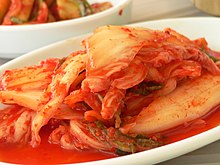
korea's traditional food ; Kimchi

Kimchi मसालेदार आमतौर पर Napa गोभी, daikon, या कभी कभी ककड़ी, सामान्यतः अदरक, लहसुन, scallions के एक नमकीन में किण्वित के साथ बनाया सब्जियों को संदर्भित करता है, और मिर्च काली मिर्च.वहाँ अंतहीन किस्में हैं, और यह एक साइड डिश के रूप में सेवा की है या सूप और चावल के पकवान में पकाया.कोरियाई परंपरागत kimchi पर्याप्त बनाने के लिए पूरी सर्दियों के मौसम के लिए पिछले है, हालांकि रेफ्रिजरेटर और वाणिज्यिक jarred इस अभ्यास kimchi के साथ कम आम हो गया है